Hier Kontakt aufnehmen und Anfrage stellen.
Therefore puren

The purenit FAQ compiles the most frequently asked questions about the versatile functional material purenit.
It provides comprehensive information on material properties, processing, approvals and certifications, and sustainability aspects. This provides a concise overview of the possible applications and advantages of purenit.
purenit consists of shredded rigid polyurethane foam and a PU binder. When laminated PU insulation boards are shredded, small quantities of particles from mineral-coated fleece and aluminium foil fall off in addition to the rigid PU foam; these are taken into account when determining the material properties and have no direct impact on further processing. purenit contains no wood or wood-based materials.
purenit is made from so-called production by-products, i.e. material remnants , arising for example, during edge processing or from faulty batches. This means the base material is free from undefined impurities, ensuring that purenit has a consistent and controlled property profile. Recycling in the sense of reusing waste therefore does not take place. However, by reusing the material remnants from production, waste is prevented in the first place.
purenit is moisture-resistant but not waterproof in the sense of a sealing or structural waterproofing. For example, it absorbs moisture when exposed to driving rain or splashing water, but it dries out completely again under suitable conditions (e.g. exposure to sunlight). This does not cause any material damage, and overall swelling and shrinkage behaviour is very low.
purenit is a functional, pressure-resistant insulation and construction material. Although many of the mechanical properties of purenit are comparable to those of wood-based panels (P5 / P7 boards), it may only be used in applications for which no structural verification is required.
Due to its resistance to moisture and rot, purenit is suitable for applications where exposure to moisture cannot be ruled out and would otherwise lead to material damage, for example in bathrooms and sanitary areas (bathroom furniture, partitions, etc.). At the same time, its low thermal conductivity combined with high compressive strength makes it suitable for use in components and/or component connections where a low thermal bridge effect and mechanical load-bearing capacity are required, such as in the window area. purenit meets the emission requirements of AgBB and can therefore be used indoors without restriction.
Use in outdoor areas requires suitable protection against weathering and UV radiation (e.g. coating,structural waterproofing or cladding).
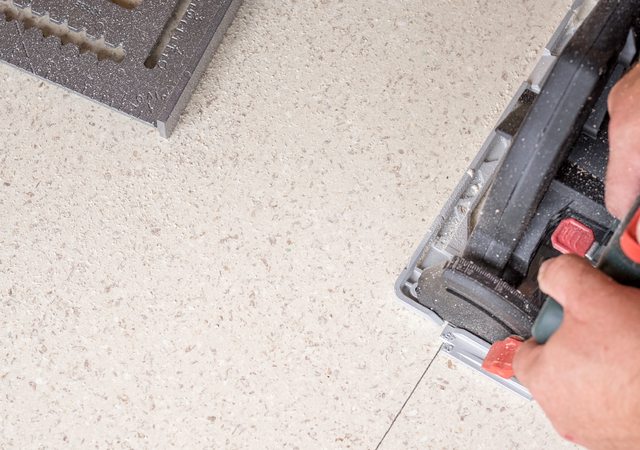
purenit can be machined with standard workshop and construction-site woodworking tools and machines, i.e. it can be sawn, sanded, drilled and milled.
Various mechanical fasteners can be used for purenit:
It is recommended to pre-drill screw holes to the core diameter of the screw, especially in areas near corners and edges. Edge distances of at least five times the screw diameter must be maintained.
purenit can be bonded using almost all types of adhesives. The choice of the appropriate adhesive depends primarily on the material to which purenit will be bonded to.
The following adhesive systems are frequently used for bonding:
Additional suitable adhesives:
Important notes on bonding:
For specific applications, the adhesive manufacturers’ recommendations provide detailed information on suitable adhesives and processing parameters such as open time, pressing time and pressing method.
purenit can be painted or surface-treated using common paints and coating systems, including solvent-based products. It is important to prepare the surface if necessary (light sanding and priming) and to ensure that any multi-layer coating is suitable for the intended application area, particularly with regard to weather exposure. Recommended paints / coating systems:
For outdoor use:
purenit is very adhesive-friendly and therefore easy to laminate; to prevent deformation, both sides should be coated as symmetrically as possible. Possible coating materials include, for example:
Ensure a uniform bonding surface and select a suitable contact adhesive or PUR adhesive according to the chosen bonding method. Coating temperature: approx. 15–25 °C. Preliminary bonding tests are recommended.
Standard plaster systems achieve good adhesion on purenit (possibly with a bonding agent). Due to the thermal expansion behaviour of purenit, the application area is limited to small sections with proper mesh reinforcement. For larger areas, such as roller shutter box covers, plaster carrier boards (ETICS insulation boards) should be bonded on.
It is generally possible to install tiles on purenit.
Applications using purenit that require structural verification are not covered by building authority approval.
do not require building authority approval.
The fastening of windows that are not required to provide fall protection does not require building authority approval.
purenit is therefore frequently used as a support shim or support plate under window frames, as a frame extension, or for front-of-wall installation systems.
The “Blue Angel” certification system currently does not provide an assessment option for PU insulation materials. As purenit consists largely of PU, certification is therefore not possible.
Certifications according to DGNB, BNB, QNG, LEED or BREEAM are awarded to entire buildings, not for individual construction materials.
purenit does not violate any devaluation or exclusion criteria in building certifications according to DGNB, BNB or QNG. In particular, purenit is free from the following substances or substance groups:
Compliance with the requirements of LEED and BREEAM has been evaluated and confirmed by an auditor.
The airborne sound insulation of monolithic (single-layer) components made of purenit can be estimated based on component mass. A technical expert opinion from a renowned building physics institute is available.
Sound insulation of multi-layer components is difficult to estimate and can only be reliably verified through appropriate testing.
The fire behaviour of purenit is classified in accordance with DIN EN 13501-1 and is confirmed through regular repeat testing.
purenit is suitable for circular use and recyclable. The manufacturer puren has developed a closed-loop system in which material and cutting residues are reused:
A comprehensive life-cycle assessment in the form of an Environmental Product Declaration (EPD) is in preparation and is expected to be available in 2026.
A similar assessment document (FDES) has already been published for France.
The manufacturing process of purenit is highly efficient:
As a result, purenit has a very low CO2 footprint.